
Central Coast
Chum salmon are struggling on the Central Coast, and while other species are holding near or above average, reduced monitoring is adding uncertainty
The Central Coast, home to the highest salmon biodiversity in any region, has seen some improvements in spawner abundance across all species in the last generation. But with chum and coho still below average, and less than half of historically surveyed streams being monitored, the situation remains critical.
Chum salmon remain below average and declining in both the short- and long-term, meanwhile reductions in monitoring obscure the extent of losses. In recent years, over 50% of the regional chum salmon abundance has been attributed to the Bella Coola River, where large-scale hatchery production of chum salmon occurs†.
Sockeye spawners are above their long-term average for the first time since the mid 1990s. Historically, Owikeno Lake and Long Lake were one of the three largest salmon runs in British Columbia†. These populations have crashed in recent decades and all major commercial sockeye fisheries in the region have been curtailed.


State of Salmon - Central Coast

Our Approach
There are different ways to measure the state of salmon, and each approach tells us something unique about how salmon are doing.
CURRENT STATE is the spawner or total abundance over the most recent generation as a per cent anomaly from the long-term average and provides information on how abundant salmon are now relative to past years.
TRENDS measure the direction of change, either over the short-term (most recent three generations) or long-term (all available years). This is complementary information to the current state, and a species that has a declining trend may be a conservation concern even if the current status is above average.
Click on a species for an interpretation of the current state and trends.

Arrows indicate if the trend in abundance is increasing or decreasing.

A horizontal line indicates if the trend in abundance is stable.

A question mark indicates an unknown current state or trend due to a lack of readily accessible data.

An exclamation mark indicates critically low abundance.


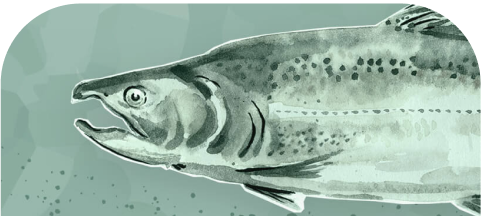
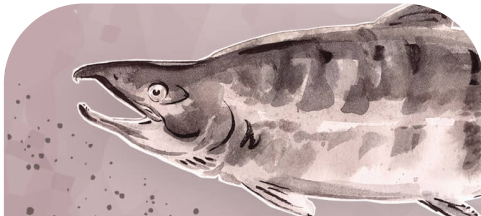
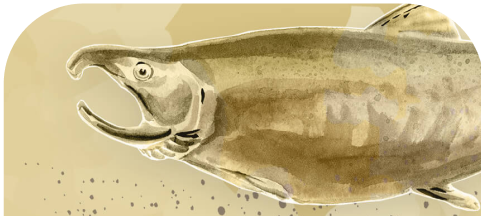
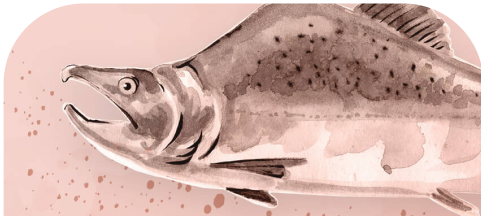
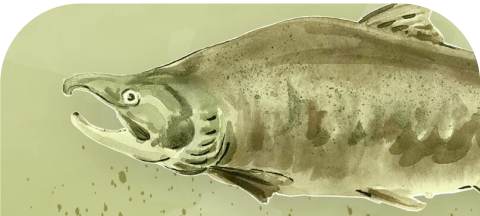
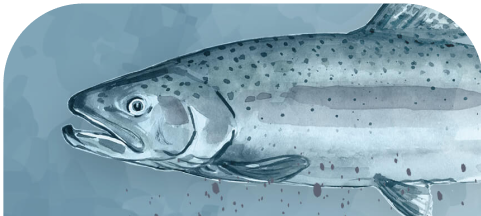
SPECIES NOT PRESENT
SPECIES NOT PRESENT
SPECIES NOT PRESENT
SPECIES NOT PRESENT
SPECIES NOT PRESENT
SPECIES NOT PRESENT
SPECIES NOT PRESENT
SPECIES NOT PRESENT
SPECIES NOT PRESENT
SPECIES NOT PRESENT
SPECIES NOT PRESENT
SPECIES NOT PRESENT
How to Interpret this Graph
Each fish above shows the per cent anomaly of current spawner abundance or total abundance over the most recent generation compared to the long-term average (horizontal line) for each region and species.
Interested in learning more? Check out the Pacific Salmon Explorer for a data-driven look at Pacific salmon Conservation Units and their habitats within each region.
For more details on our assessment approach, view our Methods.
Well above long-term average. No conservation concern.
Above long-term average. Current outlook is good.
At or near long-term average. Precaution is warranted.
Below long-term average. Current outlook is poor.
Well below long-term average. Significant conservation concern.
Critically low. At risk of local extinction.
Unknown state due to a lack of readily accessible data.

REGION PROFILE
Central Coast
Conservation Units are irreplaceable groups of salmon that have unique genetic and life-history traits. Maintaining multiple Conservation Units within a region strengthens the resilience of the species as a whole and helps it withstand and adapt to changing conditions. The number of Conservation Units provides a good indication of the salmon biodiversity in the region.
Notable Salmon-Bearing Rivers
The Central Coast Region is part of the Great Bear Rainforest, one of the largest remaining tracts of intact temperate rainforest left in the world. The Central Coast stretches from Douglas Channel and Banks, McCauley, and Pitt Islands in the north to Rivers Inlet and Smith Inlet in the south, covering 54,813 square kilometres. It comprises large inland fjords, thousands of coastal islands, and numerous small- to medium-size rivers that drain more than 132,400 square kilometres of streams into Hecate Strait and Queen Charlotte Sound.
With a diversity of stream, river, lake, and estuary habitats, the region offers some of British Columbia’s most intact and productive spawning habitats, which support a rich diversity of salmon. All six species of salmon and steelhead occur on the Central Coast, with hundreds of uniquely adapted populations.


