
Haida Gwaii
Chinook, pink salmon, and sockeye have increased to above-average spawner abundance, while the state of chum salmon and coho in the region has worsened
The State of Salmon in Haida Gwaii has changed more than in any other region. A Haida-led sonar monitoring project on the Yakoun River has provided five recent years of data, filling a gap in previous reports and putting Chinook above average spawner abundance. Returns of pink salmon and sockeye in 2024 put those species also above average spawner abundance – a change from previous years’ reports.
In contrast, chum salmon have been declining steadily for decades and coho salmon have seen very low numbers of spawners over the past four years of data (2021-2024). For all species, reduced monitoring in Haida Gwaii since the 1980s means that this assessment may not even be capturing the full picture of salmon declines, including the loss of critical genetic diversity. Indeed, the current state for steelhead remains unknown due to a lack of available data.


State of Salmon - Haida Gwaii

Our Approach
There are different ways to measure the state of salmon, and each approach tells us something unique about how salmon are doing.
CURRENT STATE is the spawner or total abundance over the most recent generation as a per cent anomaly from the long-term average and provides information on how abundant salmon are now relative to past years.
TRENDS measure the direction of change, either over the short-term (most recent three generations) or long-term (all available years). This is complementary information to the current state, and a species that has a declining trend may be a conservation concern even if the current status is above average.
Click on a species for an interpretation of the current state and trends.

Arrows indicate if the trend in abundance is increasing or decreasing.

A horizontal line indicates if the trend in abundance is stable.

A question mark indicates an unknown current state or trend due to a lack of readily accessible data.

An exclamation mark indicates critically low abundance.


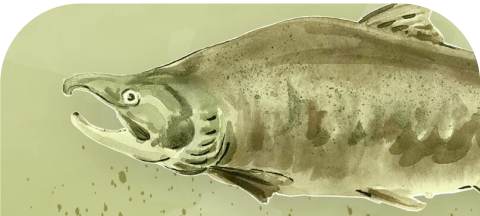
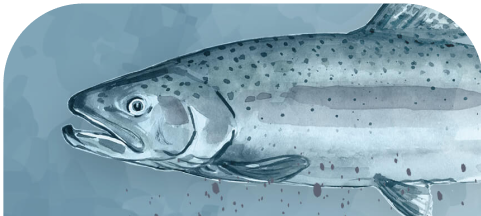
SPECIES NOT PRESENT
SPECIES NOT PRESENT
SPECIES NOT PRESENT
SPECIES NOT PRESENT
SPECIES NOT PRESENT
SPECIES NOT PRESENT
SPECIES NOT PRESENT
SPECIES NOT PRESENT
SPECIES NOT PRESENT
SPECIES NOT PRESENT
SPECIES NOT PRESENT
SPECIES NOT PRESENT
How to Interpret this Graph
Each fish above shows the per cent anomaly of current spawner abundance or total abundance over the most recent generation compared to the long-term average (horizontal line) for each region and species.
Interested in learning more? Check out the Pacific Salmon Explorer for a data-driven look at Pacific salmon Conservation Units and their habitats within each region.
For more details on our assessment approach, view our Methods.
Well above long-term average. No conservation concern.
Above long-term average. Current outlook is good.
At or near long-term average. Precaution is warranted.
Below long-term average. Current outlook is poor.
Well below long-term average. Significant conservation concern.
Critically low. At risk of local extinction.
Unknown state due to a lack of readily accessible data.

REGION PROFILE
Haida Gwaii
Conservation Units are irreplaceable groups of salmon that have unique genetic and life-history traits. Maintaining multiple Conservation Units within a region strengthens the resilience of the species as a whole and helps it withstand and adapt to changing conditions. The number of Conservation Units provides a good indication of the salmon biodiversity in the region.
Notable Salmon-Bearing Rivers
Haida Gwaii is an isolated archipelago of more than 200 islands covering 10,180 square kilometres. Hecate Strait separates Haida Gwaii from mainland British Columbia by about 100 kilometres. Salmon-bearing watersheds on Haida Gwaii range from small streams scattered along the coastline to larger well-known salmon rivers such as the Yakoun and Tlell Rivers. Often called the “Galapagos of the North”, it is home to ecologically diverse temperate rainforest and freshwater wetlands which support a diversity of spawning and rearing habitats for all species of Pacific salmon and steelhead.
Decades of industrial logging have profoundly impacted the structure and function of salmon ecosystems across Haida Gwaii. Although the legacy of logging will take decades to repair, steps have been made to protect and restore Haida Gwaii’s ecosystems†. In 1993, the Gwaii Haanas National Park Reserve and Haida Heritage Site was established to protect 1,500 square kilometres of the archipelago and, since 2012, logging rates have been significantly reduced under co-management by the Haida Nation and the provincial government.
Recreational and commercial fisheries in the region typically intercept salmon on their migrations to other spawning areas. Although the numbers of salmon that actually spawn on Haida Gwaii are relatively small, salmon are a mainstay of cultures and communities in this remote island region. Most streams have a strong return of pink salmon only during even-numbered years. Sockeye populations are smaller and are mainly harvested in First Nations Food, Social, and Ceremonial fisheries.


