
Nass
Chinook have below-average spawner abundance, while other species – including steelhead – are faring relatively well
Nass salmon currently have one of the most positive outlooks of all regions. Chinook spawner and total abundances are just below their long-term averages – an improvement from a historic low of under 5,000 spawners in 2017. All species except steelhead have increased in both spawner and total abundance over the last generation and have positive or stable short-term trends. Pink and chum salmon in particular saw record-high returns in 2025.
Although sockeye spawner abundance is above the long-term average, total abundance remains below average. The largest population - Meziadin Lake - has shown encouraging signs of recovery after failing to meet its spawning goal† for five consecutive years (2016-2020). This recent improvement offers hope for the revitalization and long-term sustainability of sockeye fisheries in the region.


State of Salmon - Nass

Our Approach
There are different ways to measure the state of salmon, and each approach tells us something unique about how salmon are doing.
CURRENT STATE is the spawner or total abundance over the most recent generation as a per cent anomaly from the long-term average and provides information on how abundant salmon are now relative to past years.
TRENDS measure the direction of change, either over the short-term (most recent three generations) or long-term (all available years). This is complementary information to the current state, and a species that has a declining trend may be a conservation concern even if the current status is above average.
Click on a species for an interpretation of the current state and trends.

Arrows indicate if the trend in abundance is increasing or decreasing.

A horizontal line indicates if the trend in abundance is stable.

A question mark indicates an unknown current state or trend due to a lack of readily accessible data.

An exclamation mark indicates critically low abundance.






SPECIES NOT PRESENT
SPECIES NOT PRESENT
SPECIES NOT PRESENT
SPECIES NOT PRESENT
SPECIES NOT PRESENT
SPECIES NOT PRESENT
SPECIES NOT PRESENT
SPECIES NOT PRESENT
SPECIES NOT PRESENT
SPECIES NOT PRESENT
SPECIES NOT PRESENT
SPECIES NOT PRESENT
How to Interpret this Graph
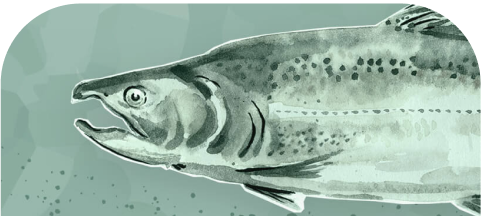
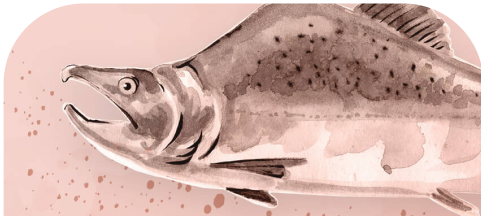
Each fish above shows the per cent anomaly of current spawner abundance or total abundance over the most recent generation compared to the long-term average (horizontal line) for each region and species.
Interested in learning more? Check out the Pacific Salmon Explorer for a data-driven look at Pacific salmon Conservation Units and their habitats within each region.
For more details on our assessment approach, view our Methods.
Well above long-term average. No conservation concern.
Above long-term average. Current outlook is good.
At or near long-term average. Precaution is warranted.
Below long-term average. Current outlook is poor.
Well below long-term average. Significant conservation concern.
Critically low. At risk of local extinction.
Unknown state due to a lack of readily accessible data.

REGION PROFILE
Nass
Conservation Units are irreplaceable groups of salmon that have unique genetic and life-history traits. Maintaining multiple Conservation Units within a region strengthens the resilience of the species as a whole and helps it withstand and adapt to changing conditions. The number of Conservation Units provides a good indication of the salmon biodiversity in the region.
Notable Salmon-Bearing Rivers
The Nass is British Columbia's third-largest river basin, with a drainage area of 20,700 square kilometres. The region supports all species of salmon and steelhead, and is the northernmost river basin that lies entirely in Canada.
Under the Nisga’a Final Agreement of 1992, the Nisga’a Fish and Wildlife Department is responsible for salmon monitoring and management throughout much of the watershed. The Nisga’a operate several fishwheels, along with a fishway at the outlet of Meziadin Lake, which are used for biological sampling and developing spawner estimates for many Nass salmon populations†. There is also a counting fence at Ksi Tsoohl Tsap that supports the only coded-wire tag indicator program on a wild coho population in the province.
The Gitanyow Fisheries Authority is also monitoring several salmon systems in the region, including the Bear River and the Meziadin River. Meziadin Lake hosts a large, naturally productive sockeye population, which accounts for 70-80 per cent of all Nass sockeye†. However, more than 250 other populations of spawning salmon contribute to high levels of biodiversity in the region.


