
Skeena
Chinook and chum salmon have declined dramatically, while pink and sockeye spawners are above average and increasing
Skeena Chinook numbers have increased annually from a low in 2020, but abundances are still far below the long-term average. The story for chum salmon is similar – below average and declining over both the short- and long-term. Coho and steelhead are also below average with negative short-term trends. Initial reports of a relatively good steelhead return in 2026 are encouraging, with the Upper Sustut weir reporting the highest since operations began in 2002.
Pink salmon continue to increase well-above average spawners and sockeye spawner abundance and total abundance are both above the long-term average for the first time since the early 2000s. Although this is a positive sign, trends in the aggregate abundance have masked the erosion of smaller, unique groups within that provide diversity and resilience to Skeena sockeye as a whole†.


State of Salmon - Skeena

Our Approach
There are different ways to measure the state of salmon, and each approach tells us something unique about how salmon are doing.
CURRENT STATE is the spawner or total abundance over the most recent generation as a per cent anomaly from the long-term average and provides information on how abundant salmon are now relative to past years.
TRENDS measure the direction of change, either over the short-term (most recent three generations) or long-term (all available years). This is complementary information to the current state, and a species that has a declining trend may be a conservation concern even if the current status is above average.
Click on a species for an interpretation of the current state and trends.

Arrows indicate if the trend in abundance is increasing or decreasing.

A horizontal line indicates if the trend in abundance is stable.

A question mark indicates an unknown current state or trend due to a lack of readily accessible data.

An exclamation mark indicates critically low abundance.


SPECIES NOT PRESENT
SPECIES NOT PRESENT
SPECIES NOT PRESENT
SPECIES NOT PRESENT
SPECIES NOT PRESENT
SPECIES NOT PRESENT
SPECIES NOT PRESENT
SPECIES NOT PRESENT
SPECIES NOT PRESENT
SPECIES NOT PRESENT
SPECIES NOT PRESENT
SPECIES NOT PRESENT
How to Interpret this Graph
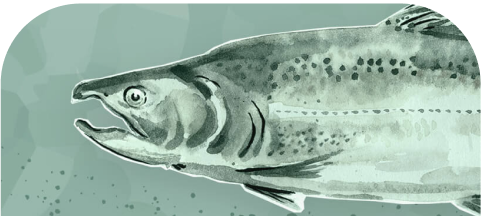
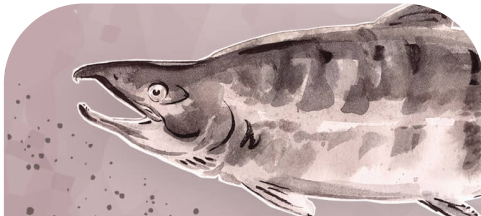
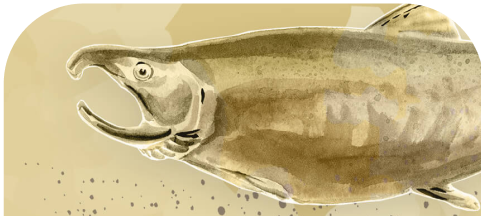
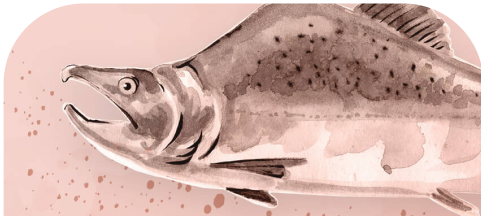
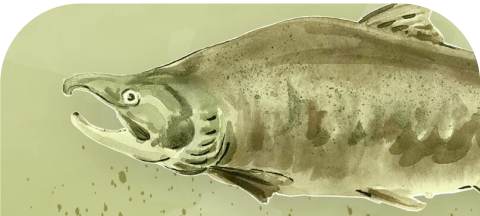
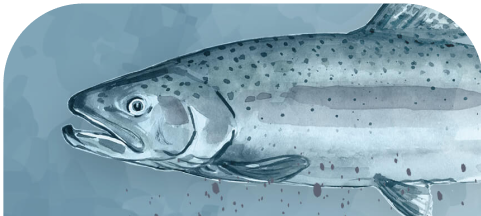
Each fish above shows the per cent anomaly of current spawner abundance or total abundance over the most recent generation compared to the long-term average (horizontal line) for each region and species.
Interested in learning more? Check out the Pacific Salmon Explorer for a data-driven look at Pacific salmon Conservation Units and their habitats within each region.
For more details on our assessment approach, view our Methods.
Well above long-term average. No conservation concern.
Above long-term average. Current outlook is good.
At or near long-term average. Precaution is warranted.
Below long-term average. Current outlook is poor.
Well below long-term average. Significant conservation concern.
Critically low. At risk of local extinction.
Unknown state due to a lack of readily accessible data.

REGION PROFILE
Skeena
Conservation Units are irreplaceable groups of salmon that have unique genetic and life-history traits. Maintaining multiple Conservation Units within a region strengthens the resilience of the species as a whole and helps it withstand and adapt to changing conditions. The number of Conservation Units provides a good indication of the salmon biodiversity in the region.
Notable Salmon-Bearing Rivers
The Skeena is one of British Columbia’s largest salmon-bearing watersheds, second only to the Fraser, and drains an area of 54,432 square kilometres. With its headwaters in British Columbia's northern interior, the 580-kilometre-long river flows southwest to enter the ocean just south of Prince Rupert.
The Skeena River watershed is one of the most productive salmon watersheds in Canada. All six species of Pacific salmon spawn and rear in a diversity of habitats found throughout the watershed, including the Skeena River Estuary and the lower mainstem Skeena River. Salmon habitat is relatively pristine but faces increasing pressures from industrial development, particularly associated with Liquefied Natural Gas (LNG) pipelines and ports.
The Skeena supports Canada’s second largest salmon fishery and an internationally renowned recreational salmon fishery. In the mid 1960s and early 1970s, two artificial spawning channels were created in two tributaries to Babine Lake - Fulton River and Pinkut Creek - to provide more spawning habitat and boost total sockeye production. Over the past 50 years, these spawning channels have fundamentally changed the composition of salmon populations in the Skeena and eroded the salmon biodiversity of the region†.
Commercial fisheries have been dwindling since the 1990s. Although Canadian fisheries for Skeena sockeye have not operated in several recent years due to low abundances, in 2024 there were opportunities for Indigenous Food, Social, and Ceremonial, recreational, and commercial harvest of Skeena sockeye. More generally, harvest rates of Skeena salmon have been curtailed since the turn of the century to also protect critically low numbers of co-migrating steelhead in the Skeena River†. However, harvest for sockeye and also pink salmon in 2022 exceeded the previous 10-year average (2012-2021)†, which - together with above-average spawners for these species - is potentially good news for the region.


